
Also on this page: Membrane Stripping & Preterm Labor

|
Prenatal-onset GBS (POGBS) Disease
may include miscarriages and stillbirths caused by group B strep and babies who are born with group B strep sepsis. Using this definition, babies infected in utero, but born live, would be considered to have prenatal-onset GBS disease which would have different prevention strategies than early-onset GBS disease. |
Currently there are no governmental health agency recommendations for the prevention of POGBS disease. However, following are several knowledge-based strategies which may help prevent unborn babies becoming infected by group B strep and other harmful organisms:
1) Urine culturing for GBS and other bacteria
In the US, this is usually done at the first prenatal visit and is different than the standard prenatal urine “dipstick” check.
Urine culturing is important because having GBS in your urine means that you are likely to be heavily colonized vaginally where GBS could potentially harm your baby. You may have GBS in your urine without having any symptoms, but see your provider promptly if you do have any symptoms of a bladder (urinary tract) infection.
Ask about the results of your urine culture:
2) See your provider promptly for an exam if you have any “vaginitis” symptoms
GBS can cause vaginitis symptoms such as:
These symptoms may be mistaken for a yeast infection and treated incorrectly. Read studies about Vaginitis & GBS HERE.
3) Avoid unnecessary invasive procedures
Invasive procedures may push GBS closer to your baby where GBS is able to cross intact membranes. Knowing how far you are dilated does not accurately predict when your baby will be born. Vaginal or perineal ultrasounds are less invasive options for internal exams although may not be readily available in all health care settings.
In the US, this is usually done at the first prenatal visit and is different than the standard prenatal urine “dipstick” check.
Urine culturing is important because having GBS in your urine means that you are likely to be heavily colonized vaginally where GBS could potentially harm your baby. You may have GBS in your urine without having any symptoms, but see your provider promptly if you do have any symptoms of a bladder (urinary tract) infection.
Ask about the results of your urine culture:
- If you have a significant level of GBS in your urine, your provider should prescribe oral antibiotics at the time of diagnosis. GBSI advocates a recheck (“test of cure”) one month after treatment.
- If you have any reportable amount of GBS in your urine, you should receive IV antibiotics for GBS during labor and delivery regardless of any future GBS test results in this pregnancy.
2) See your provider promptly for an exam if you have any “vaginitis” symptoms
GBS can cause vaginitis symptoms such as:
- external vaginal burning
- external vaginal irritation
- unusual discharge
These symptoms may be mistaken for a yeast infection and treated incorrectly. Read studies about Vaginitis & GBS HERE.
3) Avoid unnecessary invasive procedures
Invasive procedures may push GBS closer to your baby where GBS is able to cross intact membranes. Knowing how far you are dilated does not accurately predict when your baby will be born. Vaginal or perineal ultrasounds are less invasive options for internal exams although may not be readily available in all health care settings.

|
“GBSI’s Information Statement on Fetal Membrane Stripping” (en español) explains why membrane stripping (or “sweeping”) should be avoided. |
“Do Not Strip Membranes in the Presence of Group B Strep and Here’s Why” by Dr. James A. McGregor. This video contains ultrasound footage illustrating active uterine transport in both a non-pregnant and pregnant patient.
Video testimonials by providers as to why they avoid stripping membranes can be viewed on GBSI’s YouTube channel.
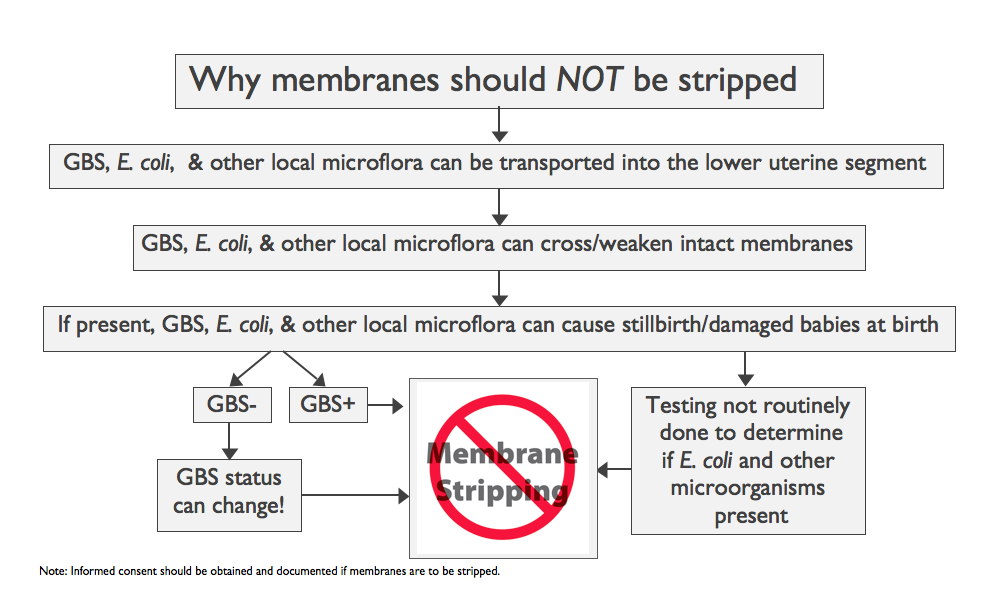
GBSI’s poster “Why membranes should NOT be stripped” below (en español) explains why membranes should NOT be stripped even if a woman tests negative for GBS! It is important to note that E. coli and other local microflora can also cross/weaken intact membranes.
Video testimonials by providers as to why they avoid stripping membranes can be viewed on GBSI’s YouTube channel.
GBSI’s poster “Why membranes should NOT be stripped” below (en español) explains why membranes should NOT be stripped even if a woman tests negative for GBS! It is important to note that E. coli and other local microflora can also cross/weaken intact membranes.
4) Know the signs of infection in unborn babies!
Reasons to contact your provider immediately:
- Decreased or no fetal movement after your 20th week
- You have any unexplained fever
GBS can also cause preterm labor and premature rupture of membranes, causing your baby to be born too early.
It's important to know the warning signs of preterm labor. Call your health care provider right away if you experience any of the following:
It's important to know the warning signs of preterm labor. Call your health care provider right away if you experience any of the following:
- Your water breaks
- You have more vaginal discharge than usual or your vaginal discharge changes
- Vaginal bleeding
- Increased pressure in your pelvis or vagina
- Cramping in your lower abdomen or period-like cramps
- Nausea, vomiting, or diarrhea
- Dull lower backache
- Regular or frequent contractions
Combatter le Strep B!- Faites un don
- Partager votre histoire - Distribuer des flyers sur la sensibilisation au STREP B - Aider nous à traduire les documentations - Faite nous parvenir des articles ou sites en ligne relatant du Strep B |
SE CONNECTER à GBSI
|
|
|

|
Vous cherchez....nous donnons! Utilisez GoodSearch.com pour vos recherches sur le Web et nous recevrons un centime à chaque fois que vous effectuerez une recherche!
|